
Kuroshitsuji Soundtrack – Kuroshitsuji Sound Complete Black Box – Review
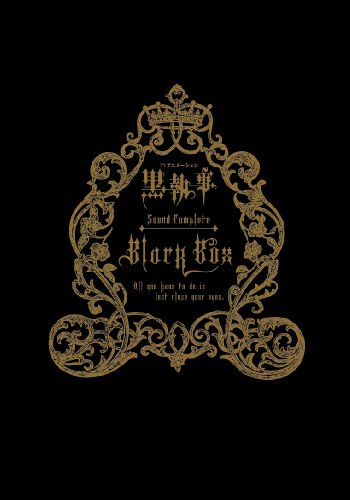
| Album Title: | Kuroshitsuji Sound Complete Black Box |
|---|---|
| Anime Title: | Kuroshitsuji |
| Artist: | Taku Iwasaki; Daisuke Ono; SID; BECCA; Kalafina; Yuki Kajiura |
| Catalog Number: | SVWC-7646 |
| Release Type: | Soundtrack |
| Release Date: | August 26, 2009 |
| Purchase at: | CDJapan or Play-Asia |
Disc 1
[spoiler]
| Track Title | Artist | Time |
|---|---|---|
| 1. Nigram Clavem | Taku Iwasaki | 1:31 |
| 2. Prologue | Taku Iwasaki | 0:10 |
| 3. Master of Tea and Scones | Taku Iwasaki | 2:47 |
| 4. Die Hasen! | Taku Iwasaki | 2:28 |
| 5. La gardenia | Taku Iwasaki | 3:24 |
| 6. Shitsuji taru mono | Taku Iwasaki | 2:36 |
| 7. Ura shakai no chitsujo | Taku Iwasaki | 2:59 |
| 8. The butler | Taku Iwasaki | 3:25 |
| 9. Coffin Man | Taku Iwasaki | 3:07 |
| 10. The Dark Crow Smiles | Taku Iwasaki | 5:24 |
| 11. Ciel | Taku Iwasaki | 2:19 |
| 12. Faint Smile | Taku Iwasaki | 3:24 |
| 13. Jazzin’ | Taku Iwasaki | 2:35 |
| 14. Di’a’vertiment | Taku Iwasaki | 2:42 |
| 15. Home Again | Taku Iwasaki | 3:32 |
| 16. Eikoku no Yami | Taku Iwasaki | 2:50 |
| 17. Nidoto modora nai taisetsu na | Taku Iwasaki | 3:01 |
| 18. Oute o Checkmate | Taku Iwasaki | 2:47 |
| 19. Wie schon! | Taku Iwasaki | 2:49 |
| 20. In memory of Madame Red – Lady in Red | Taku Iwasaki | 2:41 |
| 21. Color of Licorice | Taku Iwasaki | 2:01 |
| 22. A diabolic waltz | Taku Iwasaki | 3:11 |
| 23. Intermission: Sebastian Michaelis Version | Taku Iwasaki | 0:09 |
[/spoiler]
Disc 2
[spoiler]
| Track Title | Artist | Time |
|---|---|---|
| 1. Intermission: Ciel Phantomhive Version | Taku Iwasaki | 0:10 |
| 2. Si deus me relinquit | Taku Iwasaki | 6:55 |
| 3. Doll House | Taku Iwasaki | 1:42 |
| 4. Lizzy | Taku Iwasaki | 2:53 |
| 5. The Stranger from India | Taku Iwasaki | 2:48 |
| 6. Jyo Agya | Taku Iwasaki | 2:47 |
| 7. “Kami” ni tsukaeshi sha | Taku Iwasaki | 3:09 |
| 8. Rudra | Taku Iwasaki | 2:41 |
| 9. The right hand of God | Taku Iwasaki | 3:06 |
| 10. Small wild flower | Taku Iwasaki | 2:30 |
| 11. Ich bin der Welt abhanden gekommen | Taku Iwasaki | 3:58 |
| 12. Never More | Taku Iwasaki | 3:29 |
| 13. Hokori takaki Joou no inu | Taku Iwasaki | 2:58 |
| 14. The Dark Crow Smiles [remix] | Taku Iwasaki | 4:02 |
| 15. Call Thy Name, “Stella Mystica” | Taku Iwasaki | 3:53 |
| 16. A Gleam in the Distance | Taku Iwasaki | 5:10 |
[/spoiler]
Disc 3
[spoiler]
| Track Title | Artist | Time |
|---|---|---|
| 1. Kiss of Monochrome | SID | 1:54 |
| 2. I’m ALIVE! | BECCA | 3:14 |
| 3. Lacrimosa | Kalafina; Yuki Kajiura | 4:14 |
| 4. Anata no Koe ga Iroaseyou tomo, Meiyaku no Uta ga sono Mune ni Todokimasu you ni |
Daisuke Ono | 4:27 |
| 5. Tsuki no Ame | Daisuke Ono | 5:10 |
[/spoiler]
Tracklist provided by Ayumikat at the Brownie Post.
Review: Taku Iwasaki, while still a strong composer, hasn’t delivered as consistent an effort as he had in the past. Whereas before, he had composed the excellent Rurouni Kenshin OVAs, Read or Die, and Witch Hunter Robin soundtracks, nowadays, the quality of his work has varied, from the highly-acclaimed Tengen Toppa Gurren Lagann to the completely lackluster Black Cat. Kuroshitsuji’s soundtrack falls in the upper-middle part of the quality spectrum. The first disc on the soundtrack manages to depict the elegant, yet ominous aura of the anime’s setting, though it doesn’t strive to do much more than that, saving the best parts for the second disc which mixes some of the better orchestral tracks along with some Indian-themed music. The variety to be had in the second disc makes it engaging and through that, the soundtrack as a whole feels fresh and enjoyable as a result.
So while the first disc doesn’t include the best that Iwasaki has to offer, it is nevertheless a competent effort, especially in sculpting the tone for the anime’s setting. “Nigram Clavem” sets up that dark, ominous aura through a Gregorian chant to make one feel a sense of unease through the female vocalist’s stuttering, halting delivery and tracks such as “The butler” reinforce the unease through a melody that that cloaks the subject of the piece in a shroud of enigma. “A diabolic waltz” furthers the enigma through a smooth dance that combines an upper-class feeling of elegance and grace that carries a foreboding tone and in doing so, manages to capture both the aristocratic aspect and the supernatural elements of the anime series.
Nigram Clavem
[audio:1-01 Kuroshitsuji.mp3]
A diabolic waltz
[audio:1-22 Kuroshitsuji.mp3]
As you might expect, the lofty, aristocratic auras are given their chance to shine. “Master of Tea and Scones” works through a Baroque melody that brings to mind a scene in which a group of aristocrats are mingling about and talking about the issues of the day. What I find interesting about this piece’s execution is its use of the saxophone which, though it’s not commonly looked upon as an instrument one would use to depict the aristocracy, draws out an aura of sophistication and snobbery. “La Gardenia” aims more for majesty than sophistication, but its stirring, operatic delivery projects an aura of grandiosity so well that it’s one of the more enjoyable tracks if you like the pompous operatic songs. And if “La Gardenia” is your type of piece, you’ll also appreciate “Wie schon!” where the singer’s sense of urgency meshes well with the foreboding violin section in the background.
La Gardenia
[audio:1-05 Kuroshitsuji.mp3]
Most of the other tracks on that disc are enjoyable enough and if you happen to enjoy ambient tracks, the first disc should suit you just fine. Nevertheless, there are a few that you should watch out for and maybe skip altogether because they are downright terrible. The biggest offender is “Die Hasen!” which I’d charitably describe as a banshee wailing because the singer’s execution is so discordant and out of tune that I suspect that it was deliberate and done for a comical purpose. That, unfortunately, is of no comfort to those of us who have to actually sit through the whole thing and it’s better to pass over altogether. Thankfully, “Die Hasen!” is about as bad as it gets; the others are lackluster at worst. For example, “Shitsuji taru mono” feels as though it should be a comical piece, except that it doesn’t capture the goofy atmosphere all too well because its jazzy saxophone melody sounds kitschy, like the music you’d hear in a room full of video poker machines. “The Dark Crow Smiles” also isn’t too compelling, mostly because it fritters away its opportunity to nail the dark atmosphere through a campy-sounding narration.
Die Hasen!
[audio:1-04 Kuroshitsuji.mp3]
The Dark Crow Smiles
[audio:1-10 Kuroshitsuji.mp3]
The second disc is where most of the better tracks lie and the disc wastes no time in getting you into the mix of things with “Si deus me relinquit’s” mournful melody that creates a God-forsaken feeling. Once the track reaches the 1:35 mark, the piece really opens up with a majestic melody that hides within it a tone of loneliness and despair that can be overwhelming at times. “Si deus me relinquit” goes through a few transitional interludes which help to keep the listener engaged through its intensity and dramatic flair, leaving the listener in awe by the time it ends. Although some pieces like “Never More,” which uses a flute to create a despondent, unnerving feeling, and “Call thy name, ‘Stella Mystica,'” whose menacing tone done through a singer and a piano in the background captures the feel of a forbidden dark ritual, none of them are as enjoyable as “Si deus me relinquit” which grabs you through the raw power of its emotions.
Si deus me relinquit
[audio:2-02 Kuroshitsuji.mp3]
Call thy name, “Stella Mystica”
[audio:2-15 Kuroshitsuji.mp3]
The Indian tracks also bring a bit of character to the soundtrack. Though the music doesn’t strive for something beyond stereotypical traditional Indian music, its strength lies in the novelty factor. It’s not often that one gets an opportunity to listen to Indian music, and being able to do so makes for a nice change from all the ominous orchestral tracks. For that, these tracks are worth checking out, especially if one is fond of ethnic tracks that cover the gamut of soothing sitar melodies to energetic Indian chants that convey an exotic aura.
rudra
[audio:2-08 Kuroshitsuji.mp3]
Although the third disc includes an excellent set of tracks ranging from SID’s “Kiss of Monochrome” to Kalafina’s “Lacrimosa,” Kuroshitsuji’s soundtrack’s strengths still lie in the BGM on the first two discs. Iwasaki has done an excellent job of bringing together the aristocratic tones and the ominous, foreboding auras that makes up a large part of the show’s supernatural side while also mixing in Indian rhythms, chants, and melodies. The effort is solid all around and though there are a few earaches, those comprise a few tracks which are easily compensated for by tracks like “La gardenia” and “Si deus me relinquit.” So whether you’re a big fan of the series or of Iwasaki, you should find this album to be an enjoyable listen since Kuroshitsuji is one of his better works as of late.
Rating: Very Good

LoL..I agree with you completely that ‘Die Hasen’ is the oddest track of the lot. It’s one I skipped through each time I put on the disc. From what I can gather elsewhere, ‘Si deus mi relinquit’is a favourite of many and most that had a chance to listen to the album chose it as the stand out track from the ost. Oh yes, excellent review once again. Your description made me hear certain things differently now…not fangirling all over the place. 😛
I only saw a few of the beginning episodes, but I think I recall hearing “Nigram Clavem”. That song matches the anime with the feeling that some secret ritual is going on that is linked to evil. Love the Gregorian chant in it as well.
Die Hasen! Rofl.
@ayumikat
Can’t say I’m too surprised about “Si deus me relinquit” since I thoroughly enjoyed sitting through that one because it conveys a wonderful range of emotions without ever getting repetitive or boring, making it a sign of a strong track. But yeah, thanks for bringing this soundtrack to my attention. Enjoyed listening and reviewing it a lot!
@Reltair
There are just some tracks that come once in awhile that will make you go “lolwut” and “Die Hasen!” would be it for this album. I have difficulty figuring out what they were trying to do there and no one’s given me the context with which I can judge.
Die Hasen is the odd one out, but there tends to always be a track or two in an OST album that’s kind of just weird.
I really like Si deus me relinquit too.
@Yi
Yeah, even some of the best tracks have a few odd tracks here and there. Still, the important thing is that it doesn’t ruin the overall feel of the soundtrack and “Die Hasen” avoids doing just that.
I never knew he composed for Black Cat too! Though despite watching Kuroshitsuji, the soundtrack didn’t leave that deep of an impression. >.<
@Jen
I’ll admit that the music was at the periphery when I watched the series (and subsequently dropped it) but when I did watch it, my mind did make out Iwasaki’s style, so I had to jump all over that one. Maybe this album is better as a standalone listen?
I would actually like to say something about the supposed “bad” track of “Die Hasen”. If you’ve seen the first OVA of Kuroshitsuji, that song was actually used in a “fake” commercial featuring Pluto, advertising his favorite dog-food. Though the singing isn’t really there, it actually fits the commercial/break in the OVA.
I recommend watching it because one) its Kuroshitsuji and two) it features a play written from Shakespeare that is almost, if not exactly, similar to Ciel in the most ironic of ways.
As for “Shitsuji taru mono”, it is used in episode 9, I think, or perhaps some other episode where Ciel told the three servants to take of picture of Sebastian with a special camera.
I’ve only heard of the composer once (from Kuroshitsuji) so I wouldn’t know his style well enough to make an accurate judgement on him or his music but in all honestly, I think many people are judging quite harshly on just one or two soundtracks in the first disc. Its really a hard anime to make soundtracks to, to me, because it is set back in the Victorian era, where music was almost seriously composed of mainly strings and piano. So I think he did a seriously good job of trying to get the feel without making it sound too boring or “droopy”. And again, this is only my opinion (;
@kyotoprincess
I’m sure that it all makes sense given context though in a case where I don’t have the context anchored in my mind, I can only say so much. So with “Die Hasen,” I’m sure it makes complete sense and never clashes with the scene in which it’s played. Liking it outside the anime is something different altogether though.
I think Iwasaki’s works is worth looking over. He’s had ups and downs, but on the whole, he’s a solid composer. Personally, I can name about 2-3 composers who could score such a soundtrack (Iwasaki is one, he’s done plenty of darker fare, Kajiura works here quite well actually, and the people who composed Death Note show promise). Heck, Kunihiko’s work for Victorian Romance Emma might be worth a shot too since he did a good job with it though I’m not sure how well he works the dark, gothic themes.
And besides, I did rate this album a “Very Good,” which means I thought it was very good 😛
how can i download the songs above???please tell me….
@jasmine
Sorry, we don’t answer download questions here.
Pingback:Previewing the Music for Spring 2011′s Anime Season
Pingback:Composer of the Month – Taku Iwasaki
Could you please tell me what’s the name of the song(and where can I listen to it) Hannah sings in the last episode of Kuroshitsuji 2?
Pingback:Acacia Bollinger (acaciabollinger) | Pearltrees
“die hasen” is really strange song,when i hear it.and about what i ask yesterday i’m sorry i can’t find the link.T.T
i love si deus me relinquit!
… never can i find a kuroshitsuji song of episode 10 minute 15:13, not in the soundtrack 🙁
if anyone knows, tell me.
Pingback:An Interview with Animenz and TehIshter - Anime Instrumentality Blog
I want a soundtrack that is played behind in episode 18 when angela fought with Sebastian in the church during a cult ritual.. please help me out. And it was also played in episode 20 when Sebastian was escaping from the torture cell.